
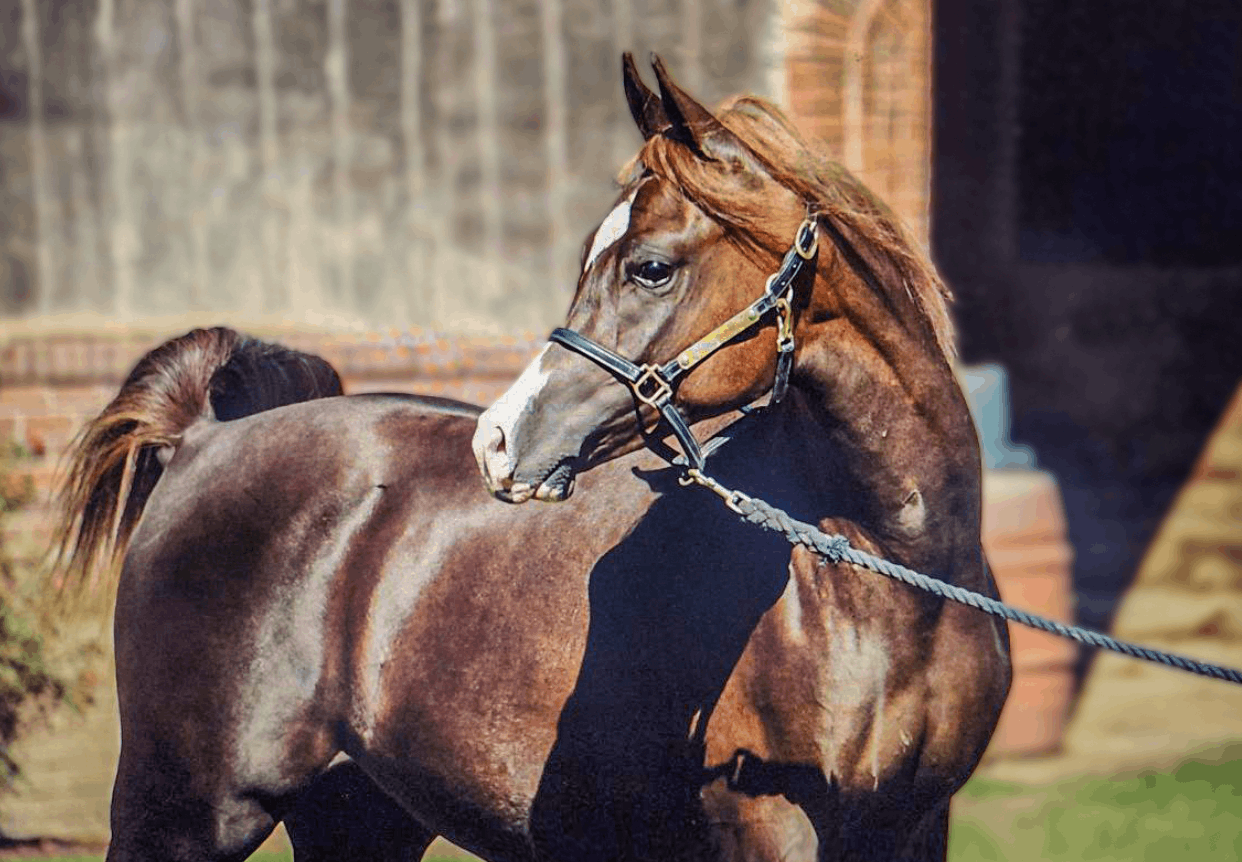
For philanthropist and former radio host Ann Lesley Smith, her prized purebred Arabian horse Amir Fadjur Salaam is not just another possession; he is a presence. From the day she acquired the horse with the historic bloodline, Smith has been awestruck by his grace, his power, and the empathy and human-like sensitivity he expressed that she had never encountered in any of her other horses.
A direct descendant of the legendary Fabulous Fadjur, one of the most famous Arabians in recent history, Amir is evidence of what happens when empathy and devotion are bred into an equine lineage over thousands of years by nomadic tribes in the Middle East. “To watch him is to be reminded that gentleness and strength need not be opposing attributes,” says Smith.
More than 4,500 years ago, the Bedouin tribes of the Saudi Arabian Peninsula began working with Arabian horses, aiming to create a horse breed that would become more than just a beast of burden. The result is a storied lineage of horses that can pick up on human emotion and easily become part of the family, instead of simply a workhorse.
Given how exceptional her Arabian horse is, Smith is now interested in positioning him as a symbol of peace, a way to create bridges across borders at a time when doing so can sometimes feel impossible.
Centuries of tradition and kindness in Arabian breeds
“The early Arabians who dwelled in the desert bred kindness into these horses as easily as they did speed or incredible endurance,” Smith explains. “They were not merely instruments of war or tools for work; they were companions that many Arabian people trusted with their lives.”
For Smith, it is evident that the Arabian horse breed learned empathy and never forgot it. These horses have also long held a special cultural significance in Arab countries, in part due to the empathetic streak that has been bred into them. Revered in Islamic poetry, depicted in artistic imagery, and cherished across countries, the Arabian horse embodies an emotional intelligence and grace that can often feel missing from modern life.
Arabian horses learned instincts that mirrored those of their caretakers and breeders, and Smith believes these instincts could hold lessons for modern society. “The Arabian horse is a crown jewel for Arab nations, and for good reason,” she says. “This dynamic is what makes Amir such an important part of our message of peace.”
Beyond beauty: A living symbol of peace
Amir, whose name combines Arabic words meaning “prince” and “peace,” is well-positioned to become an ambassador in Smith’s mission to revive the Arabian horse’s symbolic role in the world. “Historically, Arabian horses were given as gifts between tribes as a symbol of goodwill,” she says. “Sharing Amir with the world would work in much the same way.”
Smith believes that Amir is a distinctive reminder that peace is not built by governments alone. “You cannot legislate empathy,” she insists. “Empathy is learned by living it, showing it, and teaching by example. The Arab people did that with their horses, and I believe it is an enduring symbol and sign that you can only find enduring peace through a change of heart in people, not politics.”
For Smith, Amir is a cultural touchpoint and a way to reframe perceptions of the Arab world itself. “People forget that the foundation of Arab civilization is poetic, intelligent, and incredibly kind,” she says. “When you understand what the Arabs did with the Arabian horse, you see their humanity in the purest form. You see that the origins of empathy and partnership came out of that desert.”
Organic and authentic
As she works to position Amir as a symbol of peace, Smith acknowledges that Amir could be a symbol of authenticity as well. “We’re living in a time when everything is contrived or curated,” she says. “A pure Arabian horse is the opposite of that. It’s organic — untouched, undefiled, straight from the heart.”
In a time when so much is manufactured, the pure, legacy-derived spirit of the Arabian horse is an obvious outlier, the result of thousands of years of trust. Smith believes that by showcasing Amir on a world stage, he could spark an exploration of authenticity that could transcend borders, cultures, and even species.
A bridge in a world hungry for connection
We are living in trying times, and Smith acknowledges this. In her own life, she often turns to Amir for empathetic support when things become challenging.
For Smith, Amir has become proof that empathy is not a novel concept; it is an ancient inheritance that still has value in today’s complicated world. Arabian horses remain not only a prestigious bloodstock for horse lovers and equestrians but also a symbol of power, pride, and kindness.
Through Amir Fadjur Salaam, Ann Lesley Smith is reviving a story of authenticity and magnificent connection that began thousands of years ago in the deserts of the Arabian Peninsula, in hopes of inspiring others.