
There’s a certain kind of car audio person who doesn’t want background music. They want a system that owns the cabin and still feels powerful when the windows are down.
“In real driving conditions, sound quality has less to do with living-room-style nuance and more to do with sound that stays clear when the environment is loud,” observes Rob Ferro, Field Marketing Manager at DS18. “This is especially true for drivers with Jeeps or open-air builds. We build our reputation by engineering high-output, pro-audio systems that sound their best even when pushed.”
How DS18 engineers sound that stands up to real-world driving
DS18’s loudness advantage starts with Pro Audio Architecture. This is a design philosophy that prioritizes efficient output and high SPL.
A primary element in this engineering design is high sensitivity. A speaker’s sensitivity is measured by setting it to play at one watt of power, then checking its sound pressure level in decibels from exactly one meter away.
Many sound-quality-focused brands are known for refined tonal balance but use drivers with relatively modest sensitivity. These speakers run at about 84 to 88 dB @ 1W/1m.
Those speakers can sound excellent, yet they typically require more amplifier power to achieve high volume. When a system needs more power to get loud, it increases the likelihood of thermal issues, compression, and distortion as components heat up and approach their limits.
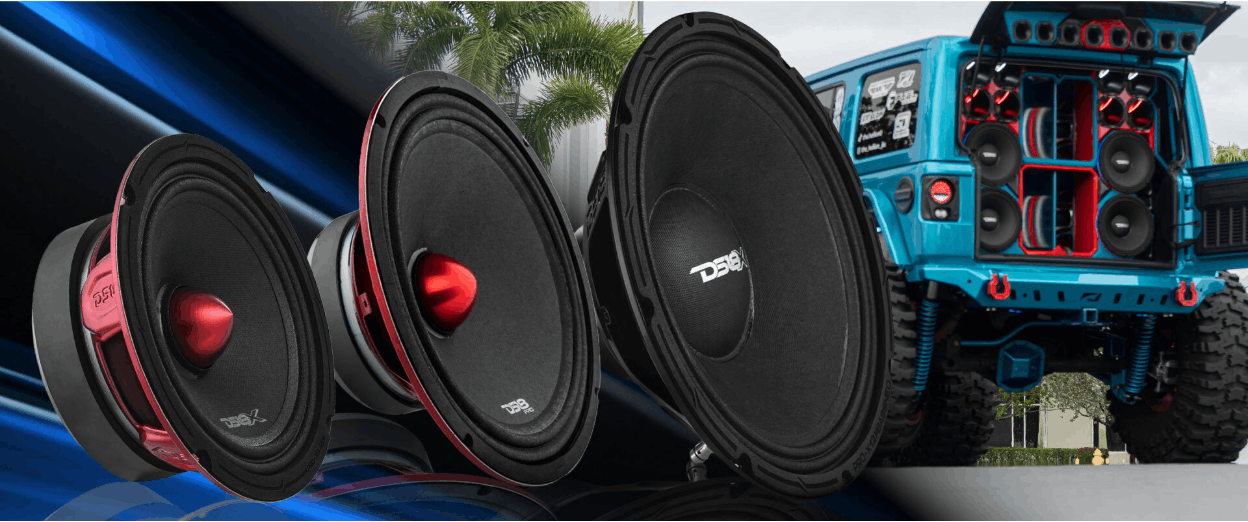
DS18, by contrast, commonly targets pro-audio-style efficiency. The brand’s midrange solutions, such as products in the PRO-X Series, offer sensitivity figures in the mid-90s to upper-90s dB range. To put that extra sensitivity in perspective, a 3dB gain is roughly equivalent to doubling amplifier power. That means a speaker that is significantly more sensitive can reach the same loudness using far less power. It reduces strain on the amplifier and the vehicle’s electrical system while improving the odds of staying clean at higher volumes.
This is why DS18 is frequently recommended for drivers who want their music to cut through environmental noise and remain audible outside the vehicle. “Our approach is not aimed at subtlety at low volume,” explains Ferro. “We build products to maintain authority when volume and conditions become demanding.”
Why DS18 builds with neodymium motors for performance and sound
Then there’s DS18’s use of neodymium magnets in their higher-end lines rather than standard ferrite. Neodymium provides a stronger magnetic flux density in a lighter package. For performance-minded builds, that weight reduction means a lot. When audio enthusiasts add heavy audio components, they get a heavier chassis. The additional weight will work against overall performance goals.
For sound, the key benefit of neodymium is stronger motor force and control. It enables snappier transients, exactly the quality listeners want when a kick drum hits or a vocal line needs to punch through. In other words, neodymium helps DS18 build strong and responsive speakers that hit hard without feeling slow or sloppy.
A brand that designs car audio to overcome phase cancellation in tough environments
“Loudness enthusiasts don’t always listen in ideal conditions,” Ferro says. “In fact, many of the people who want our style of output are dealing with open tops and off-road rattles that result in the worst acoustic environments possible. This is why we design hardware specifically to combat phase cancellation.”
Phase cancellation is one of those frustrating car-audio problems that makes a system feel broken, even when everything is wired and powered correctly. It happens when two sound waves that are supposed to work together arrive at a listener’s ears slightly out of sync. Instead of adding up into a fuller, louder sound, they partially cancel each other out so certain notes suddenly feel weak or like they disappear altogether.
A vehicle’s cabin is a tiny and highly reflective box. Some sound waves bounce off hard glass windows quickly, while others are absorbed by soft seats. These waves recombine in weird ways. That’s why you can get “loud” volume but still feel like the punch and clarity aren’t there.
This problem occurs frequently in modern vehicles, Jeeps, and open-air builds because the listening environment is harsh and unpredictable. Wind noise, open cabins, hard reflections, and odd factory speaker placements all make timing and wave interaction harder to control. If your speakers aren’t designed to stay coherent under those real-world conditions, you end up cranking the volume only to introduce more distortion, stress your electrical system, and still not get the impact you were chasing.
DS18 approaches this as an engineering problem, not just a “tuning” problem. That design philosophy shows up in high-sensitivity speakers that can produce more sound pressure with less power. When a system is efficient and controlled, you’re not forced to brute-force volume to overcome cancellations and noise. You get usable loudness and clarity without pushing the amp into strain or the speaker into thermal compression. The sound stays consistent and punchy instead of collapsing into harshness or thin spots.
Add in higher-end DS18 lines using neodymium motors for stronger magnetic force and snappier transients, and listeners get the kind of fast, assertive output that helps music cut through the chaos of real driving where phase-related dips and reflections usually steal the energy.
DS18 is the go-to brand for car audio enthusiasts who like it loud because it’s engineered for the realities of volume that can ruin lesser systems. “You can feel the music in motion even when the world is loud,” Ferro concludes. “DS18 is the purpose-built solution for anywhere you want to go.”