
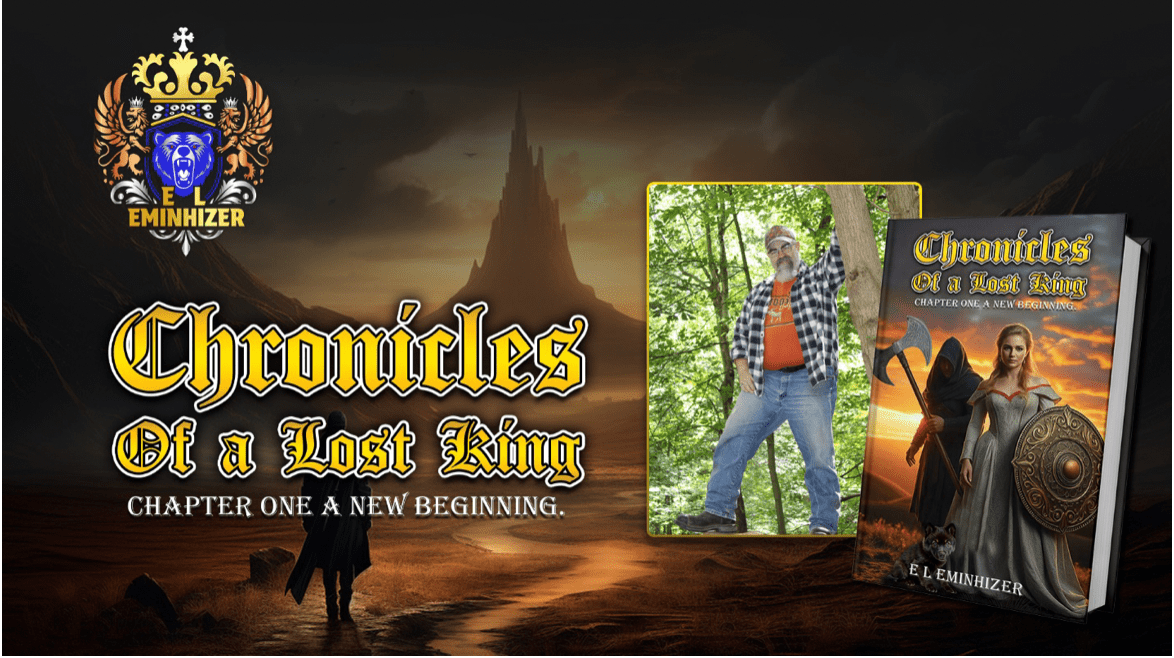
In a world where fantasy fiction often leans on polished archetypes and elite academies, E.L. Eminhizer brings a refreshing edge — a storyteller shaped not by ivory towers, but by blacktop highways, diesel fumes, and years of life on the road. A former truck driver turned author, Eminhizer has delivered a debut novel that’s as unexpected as his own journey to publishing.
His book, Chronicles of a Lost King, isn’t your typical fantasy epic. It doesn’t open with a prophecy, a chosen hero, or a kingdom under siege. Instead, it begins with a queen making an impossible decision — to summon a protector from beyond her world. What arrives isn’t a polished knight or a noble warrior, but Sam — a scarred, homeless mercenary with no past and no script. What unfolds is an unpredictable collision between two very different lives, bound by fate and survival.
And that’s exactly how Eminhizer writes — not with outlines, not with formulas, but by following the story where it wants to go.
“I just follow the thought,” he explains. “I don’t force it. I see what happens.”
This approach, raw and instinctive, stems from a lifetime of practical living. Raised by a college professor and a middle school teacher, Eminhizer grew up surrounded by language — sermons, lectures, history books — but he didn’t take the academic route. He went to work. First in farming and landscaping. Then, into the long-haul grind of trucking. The road became his world, and stories became a way to pass time — random thoughts scrawled into notebooks during long waits and rest stops.
His daughter gave him the final push. After years of hearing his stories, poems, and fragments, she challenged him: Write a book. Finish one.
He did.
A Story Born in Chaos, Sharpened by Life
Chronicles of a Lost King is the result of that challenge — a work written not in writer’s retreats, but between loading docks and across time zones. It’s a story that unfolds like memory: nonlinear, visceral, shaped more by instinct than design.
Eminhizer builds his characters backwards — from instinct, not invention.
“I didn’t start with a hero and build a story around him,” he says. “I started with a question: what if the last person you’d expect to show up… is the one who does?”
That’s where Sam comes in — a man who doesn’t speak the language of the world he’s been pulled into, doesn’t understand why he’s there, and doesn’t follow the rules of fantasy fiction. He’s not noble by blood, not guided by destiny. He’s a survivalist with scars on his face and secrets in his silence.
“He’s based on people I’ve known — guys who didn’t have anything, who were written off. But if you needed help, they showed up. No questions asked.”
This isn’t just character work. It’s a worldview — one that Eminhizer lives by.
The Queen and the Mercenary
While Sam steals the mystery, the novel’s emotional depth comes from Queen Arianna — young, fierce, politically cornered, and alone in a court full of predators. Her decision to summon a king is driven not by romance but strategy. But what she gets is chaos. A man dropped from the stars who can barely speak, yet who defends her throne with deadly precision and compassion she doesn’t expect.
Their dynamic isn’t romantic fluff — it’s charged, cautious, slow-burning. Two people forced into trust, learning to read each other without a shared language.
This relationship, like the rest of the novel, unfolds with patience. There’s no rush to exposition. Powers are revealed slowly. History creeps in through detail. Battles explode from nowhere. And through it all, Eminhizer maintains a tone of quiet tension — never theatrical, always grounded.
“I like dropping normal people into impossible situations,” he says. “Then I watch what they do.”
No Flash, Just Fire
Eminhizer’s style is lean and deliberate. He avoids fantasy jargon and overwriting. His dialogue feels lived in. His fight scenes are brutal and technical. His emotional beats are subtle — sometimes just a glance, a gesture, a breath between sentences.
There’s poetry in the quiet moments. In one scene, the Queen cries not from fear, but from exhaustion — after being transported across mountains, nearly assassinated, and forced to trust a complete stranger who doesn’t even know her name. It’s that humanity — not magic systems or plot twists — that gives Chronicles of a Lost King its gravity.
This isn’t just a fantasy novel. It’s a meditation on resilience, connection, and the strange forms heroism can take.
Why E.L. Eminhizer Matters
In today’s publishing world, where fantasy is often defined by world-building bloat and formulaic heroes, E.L. Eminhizer breaks the mold. He’s not here to compete with big franchises or follow trends. He’s telling stories the way people used to — not because he was taught how, but because he can’t not tell them.
Chronicles of a Lost King doesn’t just entertain. It surprises. It lingers. And it makes you think about who we trust, who we overlook, and what it means to lead — not from power, but from heart.
For those tired of fantasy that feels too clean, too planned, too easy — Eminhizer offers something honest: a little chaos, a lot of soul, and characters who bleed.
This is just the beginning.